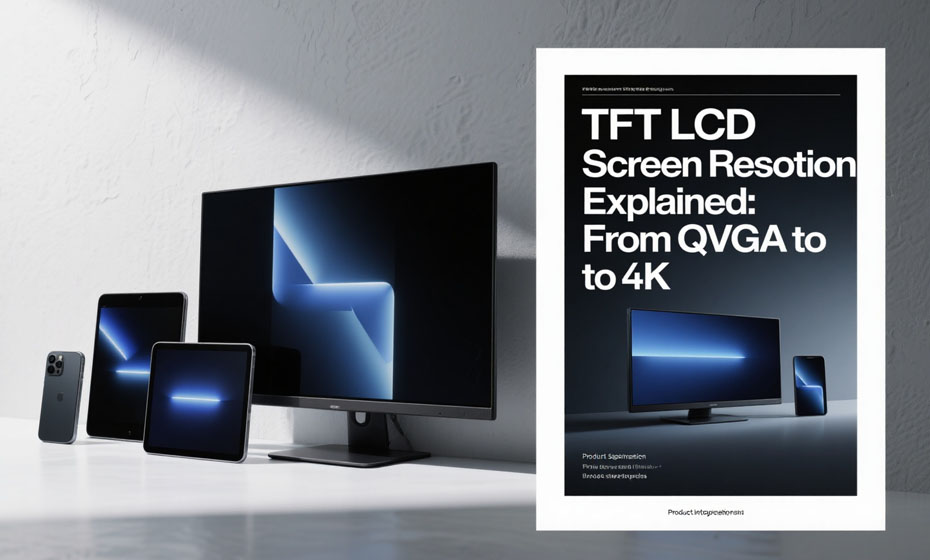
TFT LCD Screen Resolution Explained: From QVGA to 4K
Sep 18, 2025
Hello and welcome to the Gvlcd blog, your trusted resource for insights into TFT LCD technology. As a leading manufacturer of high-quality LCD displays, we often get asked a fundamental question: "What screen resolution do I need for my application?"
Understanding TFT LCD display resolution is crucial for selecting the right panel. It directly impacts the clarity, sharpness, and amount of information you can fit on the screen. In this article, we’ll break down common resolution standards, from the classic QVGA to stunning 4K, and guide you on how to choose the perfect one for your project.
What Exactly is TFT LCD Display Resolution?
Simply put, resolution refers to the number of distinct pixels that make up the display image. It is expressed as (number of horizontal pixels) x (number of vertical pixels). A higher resolution means more pixels are packed into the same screen size, resulting in a sharper, more detailed image with less visible "pixelation."
For TFT (Thin-Film Transistor) LCDs, each pixel is made up of three sub-pixels (red, green, and blue) controlled by its own transistor, allowing for precise control, faster response times, and superior image quality compared to older LCD technologies.
A Guide to Common Resolution Standards
Here’s a overview of the most common TFT LCD resolutions you will encounter.
1. QVGA (Quarter Video Graphics Array)
Resolution: 320 x 240 pixels
Aspect Ratio: 4:3
Usage: Once the standard for early mobile devices and handheld equipment, QVGA is now primarily used in low-cost, low-power industrial applications, simple consumer electronics, and secondary status displays where high detail is not required.
2. HVGA (Half-size VGA)
Resolution: 480 x 320 pixels
Aspect Ratio: 3:2
Usage: served as a stepping stone between QVGA and VGA, famously used in earlier smartphones like the first-generation iPhone. Its use has declined but can still be found in some specific industrial and medical devices.
3. VGA (Video Graphics Array)
Resolution: 640 x 480 pixels
Aspect Ratio: 4:3
Usage: A historical benchmark for PC graphics. While considered low-resolution by today's standards, VGA interfaces are still widely supported in industrial, medical, and embedded systems due to their simplicity and universal compatibility.
4. SVGA (Super Video Graphics Array)
Resolution: 800 x 600 pixels
Aspect Ratio: 4:3
Usage: Offers a noticeable improvement over VGA. SVGA is commonly found in human-machine interface (HMI) panels for industrial machinery, point-of-sale (POS) systems, and some medical monitoring devices.
5. XGA (Extended Graphics Array)
Resolution: 1024 x 768 pixels
Aspect Ratio: 4:3
Usage: For many years, this was the standard resolution for desktop monitors and laptops. It remains a very popular resolution for industrial and medical applications where a 4:3 aspect ratio is ideal for displaying data and traditional software interfaces.
6. WXGA (Widescreen Extended Graphics Array)
Resolution: 1280 x 800 pixels
Aspect Ratio: 16:10 (Widescreen)
Usage: This widescreen format marked the shift to broader displays. It is extremely common in modern industrial touch panels, portable devices, and consumer laptops, offering more horizontal space for navigation and data visualization.
7. HD / 720p (High Definition)
Resolution: 1280 x 720 pixels
Aspect Ratio: 16:9
Usage: The entry-level for HD video. HD resolution is used in smaller digital signage, automotive displays, and various multimedia devices where clear video playback is a key requirement.
8. Full HD / 1080p (FHD)
Resolution: 1920 x 1080 pixels
Aspect Ratio: 16:9
Usage: The current benchmark for high-definition content. Full HD is ubiquitous in consumer televisions, monitors, and high-end industrial displays used for detailed graphics, complex HMIs, and premium digital signage.
9. 4K UHD (Ultra High Definition)
Resolution: 3840 x 2160 pixels
Aspect Ratio: 16:9
Usage: Representing the cutting edge of clarity with over 8 million pixels, 4K delivers breathtaking detail. Its applications are growing rapidly in high-end digital signage (e.g., video walls), professional medical imaging, detailed CAD/CAM designs, and luxury entertainment systems.
How to Choose the Right Resolution for Your Application
Selecting the optimal resolution is a balance between technical requirements and cost. Here are key factors to consider at GoldenScope:
Content and Purpose: What will be displayed?
Text & Simple Graphics: Lower resolutions like SVGA or XGA may be sufficient and cost-effective.
Detailed Graphics & HMIs: WXGA or Full HD provides the necessary clarity and screen real estate.
High-Resolution Imagery & Video: 4K UHD is essential for medical imaging, video production, and premium advertising.
Screen Size: A higher resolution is necessary on a larger screen to maintain a high PPI (Pixels Per Inch) value and avoid a grainy, pixelated image. A 7-inch screen with XGA resolution will look very sharp, while a 20-inch screen with the same resolution will look poor.
Viewing Distance: Will users be close to the screen (e.g., a smartphone) or far away (e.g., a highway billboard)? The farther the viewing distance, the lower the required PPI and resolution can be.
System Compatibility & Cost: Higher resolution displays require more powerful processors and graphics controllers to drive all those pixels, which increases system cost and power consumption. Ensure your hardware can support your chosen resolution.
Interface Compatibility: Verify that your system's video output (e.g., LVDS, eDP, HDMI) supports the desired resolution.
Conclusion
From the basic clarity of QVGA to the immersive detail of 4K, understanding TFT LCD display resolution is key to building a successful product. There is no one-size-fits-all answer; the best choice depends entirely on your specific application, user experience goals, and technical constraints.
At Goldenvision, we help our clients navigate these choices every day. We offer a wide range of TFT LCD modules in various resolutions, sizes, and configurations to meet your precise needs.
Ready to find the perfect display for your project? [Contact our technical experts today] for a personalized consultation and let Goldenvision bring your vision to life with clarity and precision.




 IPv6 network supported